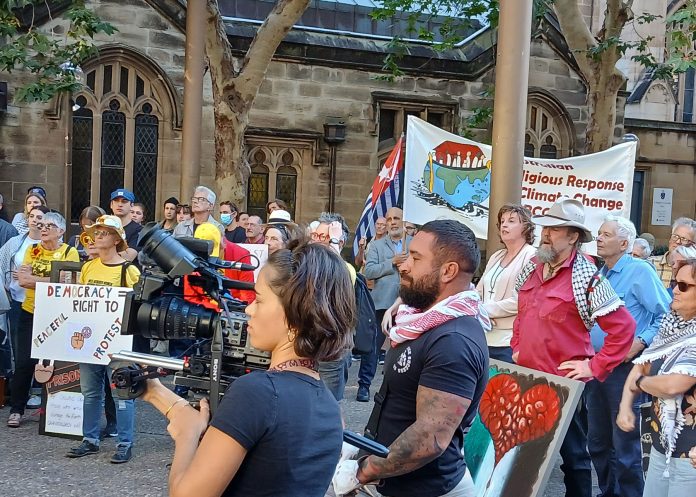
Last week, on February 20, the NSW Parliament rushed through three bills which Premier Minns described as “a strong response to recent antisemitism”.
Along with bills increasing penalties for graffiti or intentionally inciting racial hatred, a new Places of Worship Bill imposes hefty penalties for blocking, hindering, harassing or threatening people going into or out of a place of worship.
The bill also removes limitations to NSW Police “move-on” powers, making it easier to issue these orders to protesters near places of worship. Sydney’s CBD is home to 30 places of worship – theoretically students could be asked to move on while they protest climate inaction in Town Hall Square.
ARRCC, along with Amnesty International, Council for Civil Liberties and others have problems with the Places of Worship Bill. Principally, peaceful protests are being wrongly conflated with antisemitic attacks, graffiti, violence or threats, which already fall under the Crimes Act.
Put simply, no one will be any safer because of this bill.
Instead, the bill delivers more restrictions on the right to peaceful assembly, adding to the ever-increasing number of anti-protest laws being passed here and around the world.
Democracies aren’t lost overnight. They are lost piece by piece, measure by measure, each time people believing the change is too small to make a fuss.
Another problem is that the vague wording of the bill leaves much room for interpretation. Could chanting or holding placards with messages that congregants disagree with be seen by police as “harassment”?
The penalties are unreasonably harsh. Offences carry a maximum penalty of 200 penalty units or imprisonment for two years, or both! For comparison, the penalty for a first offence of driving under the influence in NSW is typically 30 penalty units and subsequent offences carry 50 units.
Many injustices have been overcome because of people getting out on the street, such as civil rights in the United States and women’s right to vote. Protest is a means by which everyday citizens can create a more just and sustainable world when they don’t have the money or slick lobbyists of wealthy corporations.
For those of us wanting to build a better world, a Review of this legislation is scheduled in two years’ time. Let’s make sure that it happens.
_______________
Thea Ormerod is President of Australian Religious Response to Climate Change (ARRCC).