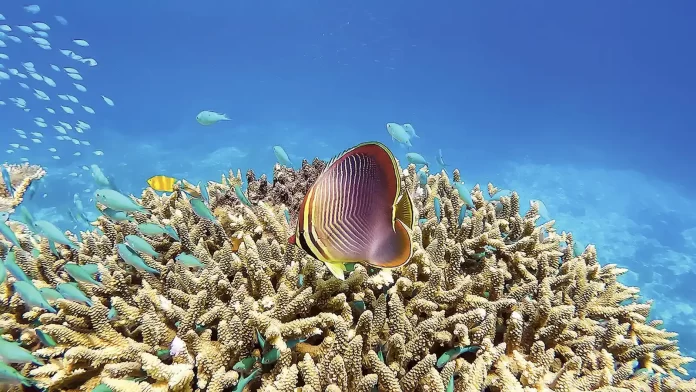
The Great Barrier Reef (GBR) is a very dynamic system, meaning that the reefs’ shapes and inhabitants are different depending on when and where you look. This is true for a snorkeller visiting different reefs, but also at the scale of the entire GBR, and over geological times. By synthesising two decades of research, scientists have recently described the reasons for this, and what supports the growth of the GBR.
Stretching over 2,300 km, the GBR is composed of individual reefs that are built by corals, tiny animals forming large colonies and producing a hard skeleton. While the animal’s body only occupies the thin surface layer, the skeleton underneath can be several metres thick, reflecting thousands of years of growth. And because growth leaves physical and chemical traces in coral skeletons, they can act as records of past events.
In 2010, Expedition 325 of the Integrated Ocean Drilling Program recovered 34 coral cores, at various depths along the GBR. Scientists extracted the information preserved within the cores and combined their findings with thousands of observations and data pertaining to the geochemistry, geophysics, seismic and thermal history of the reef to reconstitute its history. This enormous research effort spanned 40 institutions across 12 countries and resulted in 50 publications over 15 years.
Led by Professor Jody Webster of the University of Sydney, the synthesis article showed that the GBR stopped growing five times in the last 30,000 years. Mostly, the reef shifted according to glaciations and sea level fluctuations: corals either died in the open air when sea level was low, or “drowned” for lack of light when it rose too quickly. But sea level was never the only condemning factor; warming waters or degraded water quality defined the reef’s fate. “That combination appears to have been critical in determining whether reef growth could continue,” Professor Webster says.
Who knows when the GBR’s next large-scale growth interruption will occur? Professor Webster reminds us that the changes resulting from human actions (ocean warming, ocean acidification, melting glaciers) are “expected to happen much faster than previous changes that the reef has lived through”. And of course, what happens tomorrow depends on what we do today.
References
Webster, J. et al. (2026) Evolution of the Great Barrier Reef shelf-edge system in response to major environmental changes: a synthesis of IODP Expedition 325. Marine Geology. https://doi.org/10.1016/j.margeo.2026.107824