Tell us about the history of the ensemble.
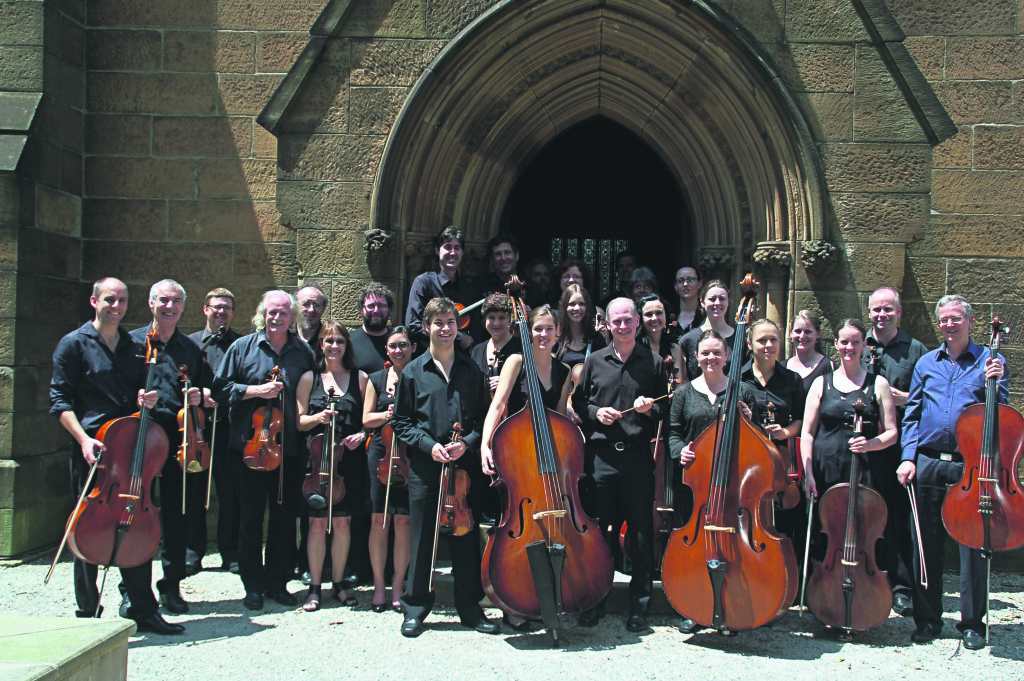
I had conducted an orchestral concert and a couple of musical theatre productions over the previous three years. In 2001, nobody wanted to give me anything to conduct, so I decided I’d better organise something myself. Fortunately, 20 years of playing in numerous amateur and semi-professional ensembles had given me a wide circle of people whom I felt I could ask. St. Stephen’s Anglican Church, Newtown, had a very fine musical tradition, so asked if it was possible to give concerts there. I was delighted that they agreed, and we are still there. The ensemble has also given concerts at the Garrison (Holy Trinity) Church in The Rocks, Macquarie University and Camden Uniting Church.
You rehearse at St Stephen’s in Newtown. What other involvements do you have with the parish?
There isn’t really any formal connection with the parish, though in recent years we have provided music for their Christmas Eve service, as a way of saying thank-you for their continued kind hospitality.
Could you share a little about who is involved in the ensemble
Music teachers, music students, academics, engineers, instrument makers, pilots, freelance musos, people who work in the financial sector, microbiologists; anyone really, as long as they are enthusiastic and have the technical ability to perform challenging and often unfamiliar music.
Richard Willgoss, a composer who has played violin with the Bourbaki Ensemble for 11 years echoes this. “The best thing is that the players take on and surpass the challenge placed before any professional group, that of, in limited rehearsal time, making vivacious music at a very high-performance standard. Of course, we play some of the well-known string orchestra repertoire. But the concerts also give opportunity to hear some rarely played works, including liberal offerings from Australian composers both past and present. All of this gives me a real kick-on in achievement value.”
We are very fortunate to have attracted the interest of many very talented soloists, often professionals or advanced amateurs, who are interested in an orchestra which does not confine itself to the standard well-known repertoire. We have performed with members of the Sydney Symphony Orchestra and the Australian Opera and Ballet Orchestra, as well as leading freelance musicians. Some years ago we gave a concert with a final-year vocal student from the Conservatorium, who shortly afterwards received a major scholarship enabling her to study in London, and is now a professional soloist.
How do you choose your repertoire? What kind of material have you covered in recent times? What might you like to include in your repertoire?
I scarcely have any idea how I choose the repertoire! Usually it begins with one or two pieces that I particularly want to conduct, or a piece that a soloist wishes to perform. Then I go through my extensive database of string music and try to find pieces that complement the initial idea. I do like to have programs that “feel right”, rather than a random selection of unrelated compositions.
One of our main aims is to support local composers: we include at least one Australian work in every concert. We have performed pieces by well-known Australian composers such as Peter Sculthorpe, Nigel Butterley and Richard Meale; by student and emerging composers; and by members of the ensemble who have an interest in composition. It’s thrilling when we can get to work with living composers, perhaps to have them attend rehearsals and help us to achieve what they really want to hear in their music.
One of the more out-there pieces we have performed over the years has been “In C” by the American minimalist composer Terry Riley. In effect, it is a 45-minute semi-controlled improvisation for the whole band.
Alongside new, unfamiliar and adventurous pieces, we are always very glad to perform the great string works of the past: music by composers such as Tchaikovsky, Dvorak, Britten, Sibelius, Richard Strauss and many, many others.
Does the ensemble have particular needs at present – new members? equipment?
opportunities to perform?
New members are always welcome, as long as they are of a high technical standard and are willing to commit the time required to master difficult music. Opportunities to perform are also welcome – we have occasionally given a program at St Stephen’s and then repeated it elsewhere the following weekend.
What does your schedule look like for 2015?
As the great Australian composer Peter Sculthorpe passed away last year, we have decided to include one of his works in every program.
We also have a fine array of soloists: a cellist, two woodwind players and two brass. To give an indication of the extent of our repertoire, our first concert consists of music from 2007, 1998, and the early 20th, late 19th and 17th centuries.
This first concert will also be a fundraiser for Derek Davies, a long-time violin and viola player with the Bourbaki Ensemble who is currently facing serious health difficulties. We hope we can use the concert proceeds to assist Derek with living expenses and ongoing treatment, as he has opted not to go down the chemotherapy path.
Derek values the friendship and support of the ensemble. “David is fantastic. He is a most inspiring conductor. Bourbaki is a very special musical gem,” he says. Derek will be performing “India”, his piece for solo viola, and arrangement of the Celtic air “Down by the Sally Gardens” for the ensemble.
The third concert features the world premiere of a Concertino for trumpet, trombone and strings by leading Sydney trombonist and composer Greg van der Struik. Greg himself will play the trombone part, with his Australian Opera and Ballet Orchestra colleague Brian Evans on trumpet.