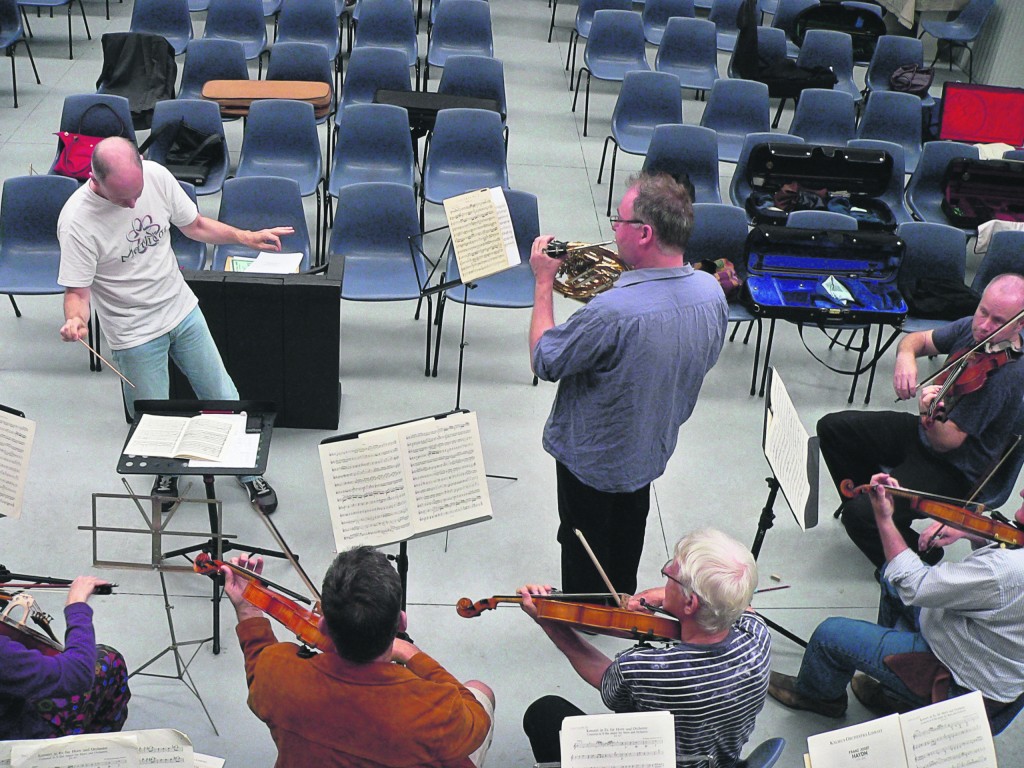
Even deciding what to play was not an entirely simple matter, as David explains. “Mozart’s symphonies are traditionally counted as 41. However, it has been known, for some time, that at least two of these were not actually by Mozart. No. 2 is nowadays generally agreed to have been written by Mozart’s father Leopold, who possibly sought to cash-in by pretending his then six-year-old son was the composer. And No. 3 is by a different composer entirely, Karl Friedrich Abel. Then, on the other hand, there are further symphonies which almost certainly are by Mozart, but which for some reason didn’t make it into the standard 41. In the end we decided to play the 41, leaving out the two ‘fakes’. This omits the probably genuine ‘extras’, but you have to draw the line somewhere and we felt that 39 separate symphonies was probably enough for a weekend.”
Enough, indeed. Although some of the earlier symphonies, composed while Mozart was still a young boy or a teenager, come in under 10 minutes – very short for a classical symphony – the last five go for about half an hour each. Even playing three or four of these begins to sound like a marathon, but doing 39 requires a huge amount of stamina from the musicians.
And from the audience too? “Audiences will certainly be welcome,” says David, “and it would be terrific if some people were there for the whole project. We don’t have time to thoroughly rehearse all the symphonies, so we will be relying on the performers’ innate musicality and past experience. Probably there will be imperfections: in recognition of this we will not be charging the audience an entry fee, though we would appreciate a donation to help cover costs.”
If each musician is faced with learning his or her own part for 39 symphonies, imagine David’s workload. As conductor, he needs to have a good knowledge of everybody’s part in every symphony. Although David has already studied a number of the pieces during his ten years conducting Orchestra 143, it’s still going to be a steep learning curve, requiring him to master a symphony every day for the next month. “I usually manage a bit on the bus going to work in the morning, and a bit more on the way home. Add in an hour or two every evening and it’s done – I hope!”
An oddity of the Mozart symphony cycle is No. 37. This is really a symphony by Michael Haydn, a friend and colleague of Mozart. Finding himself short of time to complete the symphony which his employer wanted, Haydn convinced Mozart to lend a hand by composing a slow and majestic opening for the work. “People shouldn’t take classical music too seriously,” suggests David. “We intend to play the part Mozart wrote – it only lasts a minute or two, and leaves the listener hanging in mid-air, expecting more – but we’ll take the risk of frustrating the audience. After all, we’re supposed to be playing only Mozart this weekend.”
The idea for the Mozartathon came from the other side of the world. “During 2013,” says David, “I spent some time in the UK. I conducted an orchestral concert near Oxford, and played viola in a number of performances in London. One of these was with The Angel Orchestra, based in Islington. (Yes, that’s The Angel Islington if you ever played Monopoly!) When I came home, I never thought to remove my name from its email list, and, as a result, I found that they were to play the complete Mozart symphonies at the beginning of March. It struck me as a great idea to do the same thing here on the same weekend, turning it into a world-wide Mozart marathon.”
The venue for the Orchestra 143 Mozartathon will be the East Lindfield Community Hall, 9 Wellington Road, East Lindfield.
Friday February 28, 7-10pm; Saturday March 1, 2-5pm; Saturday March 1, 7-10pm; Sunday March 2, 2-5pm; Sunday March 2, 7-10pm
No fixed charge for admission, suggested donation $1 per symphony.