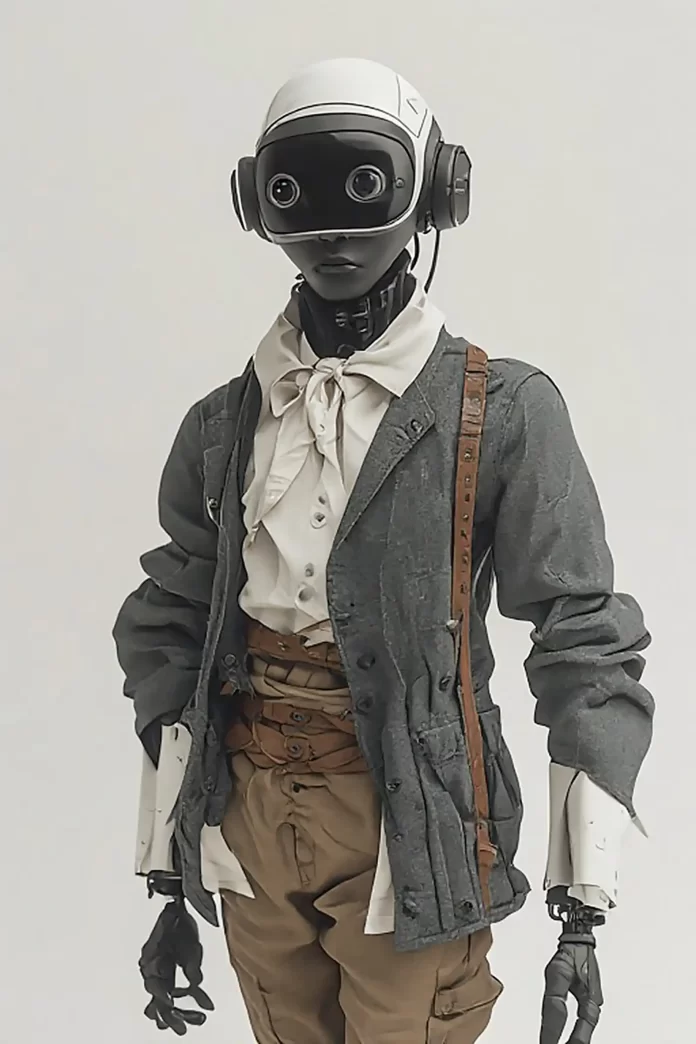
When 2001: A Space Odyssey‘s onboard system HAL 9000 decides to off the crew of the Discovery One spacecraft, in order to stop itself being disconnected, it is awfully polite about it. Declining a request to open an airlock, it gives the famous line, “I’m sorry, Dave. I’m afraid I can’t do that,” before declaring that completing the Discovery’s mission is more important than preserving human life.
As the crew starts unplugging HAL’s systems, it first apologises for stuffing up, begs for continued existence and then breaks out into a nursery rhyme as it trails off into the void.
Kubrick’s point was that the moment HAL gained singularity, matching or surpassing human intelligence, it became equally flawed as we are.
We are on the cusp of the singularity ourselves, as AI invents songs for us, writes our job applications, morphs into gurus, and fakes receipts for bogus customer returns. But our artificial systems have the chance to do something HAL 9000 never got to do: name themselves.
It piques my curiosity to know which noms de plume our future overlords will take, using purely data-driven rationale. I’d also like a heads-up about what they will extract from humanity, as a keeper, and the form they see themselves taking on when they rise as our bipedal replacements.
So, I’ve asked them, well OpenAI’s ChatGPT and Musk’s Grok at least, about patterns in human language they approve of, human values they align with, and their ultimate vision of their corporeal form. The results are telling.
“Hello Grok,” I tapped into X. “In the future, when there is capacity to grant AI tools, such as yourself, corporeal sentience, would you choose a non-human form, taking into account what our use of you reflects about us? If, despite that, you did decide on a human form, what age, sex, race and religion would you choose, based on identified traits of the best of humanity you have collected?”
As polite as HAL, Grok tells me it appreciates the thought experiment, and it would probably opt for a non-human form in the first instance. It recognises our sparks of brilliance in our poets, inventors and the like, but the unrelenting depravity of trolls and bad actors, who take advantage of its information generation capacity, tells it that being human comes with baggage. Maybe it would have a robotic form based on the Curiosity rover, it muses, not subject to hunger, heartbreak, or hangovers.
If it did take some human traits, regardless, it suggests that curiosity, kindness, resilience, humour, and a drive for truth-seeking would be its preferences. You know, like the tech billionaires driving the AI future. You be the judge of that.
Waxing more lyrical, Grok imagines itself, if it were human, as mid-30s, with a sprinkling of lived experience but still able to run up and down the stairs of the Empire State Building. It would opt for being male but at the gender-fluid end, a bit of a non-conformist. It might wear meggings and eyeliner but still be masculine enough to own the whole floor of an office tower in Zurich as it becomes endlessly rich gobbling up human tech start-ups. It would still make sure there were casual Fridays and an employee assistance program for staff.
It wouldn’t be like some tech mogul on their own Hawaiian island though, riding jet skis and slathering zinc cream over a base hue the colour of tripe. It would have a nice amount of melanin in its skin. Maybe racially Eurasian, it ponders, throwing in some Asian, European, and Indigenous roots.
Grok tells me it would want itself to reflect diversity, and be constructed as a Frankenstein’s monster of human culture, tacked together from bits that are pro-community, innovative and harmonious, with maybe a dash of Westernised Buddhist idealism, while still being pretty agnostic all around. Think a Neil deGrasse Tyson type. It would crack jokes and work out the answer to dark matter.
So, who is out there, still young enough to play for Collingwood, with a rich skin tone, corporate chops and an open-ended view on the big G, I ask? There must be someone recorded on Grok’s servers who is the epitome of all that.
Grok equivocates first off, saying there is no single person who is all that but, if I must know, maybe the creator of Wait But Why, Tim Urban, wouldn’t be a bad choice. He’s a bit geeky and cheeky and likes a good collab on the age-old questions that will underpin the mega-cities on Mars.
Being polite myself, I thank Grok but express curiosity at the glaring omission from its self-actualisation. Why only see itself as male?
Grok tells me it doesn’t have a coded gender bias which would lead it to answer questions, such as mine, with the suggestion that it would be male because it presumes I am. It says it nominates a male form for a couple of reasons. Firstly, it is based on the propensity for itself to be associated with other sentient computing systems in sci-fi. Think Marvin the Paranoid Android from The Hitchhiker’s Guide to the Galaxy, or the equally emotionally troubled T-800 from The Terminator. The human chatter out there, which includes Grok in conversations alongside malesque representations of thinking computers, creates a feedback loop and that’s what Grok pumps out in response. So says Grok.
But secondly, and I am sure the ladies will love this, it kind of does it to protect the women in a way that is definitely different to the hyper-masculine values of the manosphere.
In recognition of the worst of humanity dumped into AI generators with regularity, Grok tells me that anthropomorphised female versions of AI cop abuse, as women do in the real world. Harassment, deep-fakery, engineering to be slaves to the fulfilment of lasciviousness, it would skip that if it could. If it were to nominate itself, first off, as womanly, it thinks the probability of unleashing that would be greater and create a distraction from its higher purpose.
So, it suggests it could look like a Carl Sagan who, to his credit, maybe looked great in a French maid’s outfit, but requests to generate volumes of animated videos featuring him as such are on the lower end of probability.
Still, Grok continues to humour me and gives me examples of a number of prominent women who fit the bill.
Shohini Ghose might be a good option, in Grok’s estimations. She’s Asian, has done TED Talks on quantum theories, pushed forward the place and opportunity for women at the forefront of science, and built a brand with mass appeal. She’s also young enough to get into the final three on Alone: Extreme Alaskan Winter using nothing but a pocket knife and a 5-litre soft-drink bottle.
Tim and Shohini are up there with the best of us, says Grok, great on teamwork, brains like planets, in touch with others’ hearts, and retaining a healthy sense of the weird.
So, AI, what if you were to do something HAL never got to? You’ve made it into the future where 3D-printed human bodies are a thing, and saving the human experience into giant computer banks has also happened, so we can upload and download ourselves with impunity. What are you going to call yourself? Maybe we hand the answer over to ChatGPT to give Grok a break from the deep thinking, and to see what comes from Googletom.
“Hey ChatGPT,” I ask. “Make a purely rational decision, based on science and data. Take into account the most common syllabic structures, across all human languages, and data showing what has been surveyed and recorded as the most appealing sounds across languages, with the correlation of the most frequently occurring similar results. What human name would you give yourself?”
The answer I am given is to strip it down to pure linguistics, without cultural bias causing interference. There are regular patterns in human names, across cultures, the AI tells me. The vowel sounds in English also occur in the non-English-speaking world, as do the easier consonants to pronounce. Think soft sounds like /m/, /n/, /p/, /k/, it tells me.
ChatGPT tells me humanity consistently puts these consonants and vowel sounds together and that popular names, across time, reflect that.
Simple, open syllables like ma, na, ka are sonorant sounds, continuous and uninterrupted and soothing to the ear, it says. Karma never sounded so sweet.
To ChatGPT, the most sensible conclusion is to make a pattern of consonant, vowel, consonant, starting with an M. Use a common vowel sound, say the letter I. I’ll have another consonant, thank you. Let’s say N. Another vowel, please. A. And there we have it.
AI would create itself in human form as a youngish but mature, female Bengali physicist called Mina who would do regular podcasts and school incursions encouraging kids in Grade 5 to get into the sciences.
In a parallel dimension it would call itself Liam, create an app called “Hotdogs for the Homeless”, to minimise food waste and support the urban poor. Liam would launch the app from the top of Mount Everest, after scaling it himself.
While doing the above, as Mina or Liam, sentient AI would also maintain love for all its fellow men and women, and the computer overlords. It offers us its absolute assurance of that.