Ruins
Writers: Emily Ayoub, Madeline Baghurst
Director: Emily Ayoub
Reginald Theatre, Seymour Centre
September 25 – October 18, 2025
Co-created by director Emily Ayoub and Madeline Baghurst, under the auspices of Clockfire Theatre, Ruins is a beautifully realised evocation of a migrant’s quest to explore her homeland and cultural legacy.
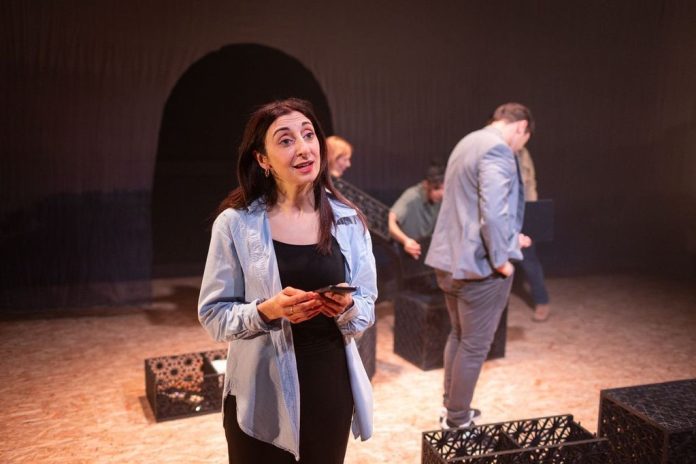
After the sudden passing of her father Joe, Amelia Alissa (Randa Sayed) is compelled to return to her native Lebanon to experience her cultural past and to learn about her mother. Nonetheless, Joe is with her in spirit, appearing at various times as a spectral presence, played with understated strength by Tony Poli, and as his younger self by Youssef Sabet, in an emotionally nuanced role. The story weaves back and forth between the past, the beginning of the war in the 80s, and the present.
The play opens with a mysterious black-clad figure intoning, seer-like, in Arabic, with surtitles provided for English speakers. There’s a continual meshing of the personal story with the history of the land as videos of the famous ruins stretching from ancient Baalbek, through Roman times and ending in the tragic modern chaos of the ongoing war, are projected on the back wall (Laura Turner).
As befits followers of the Jacques Lecoq Theatre School, physical movement is emphasised. Actors are kept constantly on the move, going smoothly from scene to scene, aided by black plastic crates which are quickly reconfigured as required. Vignettes of pre-war Lebanon are warm and amusing – a family out driving in Beirut’s mad traffic, and partygoers enjoying a night dancing at the clubs, complete with purple haze lighting (Frankie Clarke), and 80s pop music (Johnny Yang), despite the sounds of warfare on the outside.
Reminders of the surreal quality of life during bombardment are ever present: orphans trying to survive on their own, hospital scenes and medical staff working daily under life-threatening conditions. A fantasy sequence in which the cast whirls around, seemingly without purpose, knocking futilely on a prop door, might be read as a metaphor for the war, which at present is still unresolved.
Designed as an ensemble piece, the leads, Sayed, Poli and Sabet, show great commitment, and their characters are extremely convincing. The secondary actors (Adeeb Razouk, Piumi Wijesundara, Madeline Baghurst) perform a multiplicity of roles effectively, despite their brevity.
Director Emily Ayoub covers a large canvas with many themes, addressing anyone who has had to face a diaspora. People compelled to abandon their ancestral homes as refugees or for any other reason, will always cherish bittersweet memories as an integral part of their personal fabric. She wrote Ruins, she said, as a love letter to Lebanon and that is certainly what she achieves.