


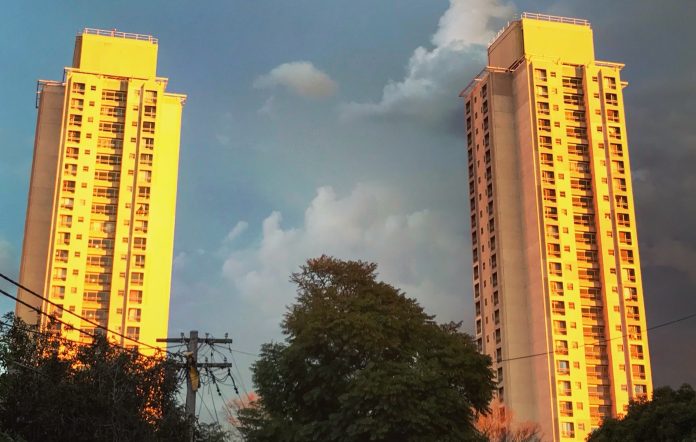
I have lived in Matavai since 2010 and am a survivor of a decade of so-called government consultation since Brad Hazzard first announced the Metro and the redevelopment of the Waterloo Estate. To his surprise, the assembled tenants were not as excited as Brad at the prospect of what in plain language meant the demolition of their homes and dislocation of their lives.
I expect several trees were demolished as the pile of paper outlining plans and provisions grew with a succession of government agencies trying to give the impression that tenants, now renamed as stakeholders, were being consulted in the rebuild. But no amount of butcher’s paper recording the tenants’ hopes for the finalised Waterloo Masterplan could conceal the fact that public housing was being shafted in the interest of private ownership and private profit.
Appalled and worried by the proposed demolition, I felt there must be a better approach than to break up a community which had such a strong sense of place and I attended a talk given by architects at 107 Projects on possible rebuilds. The last speaker, a young woman, Genevieve Zoe Murray, inspired by the dictum of the French architects, Lacaton and Vassals, “never demolish … always add, transform and reuse”, opened my eyes to what appeared the only humane and realistic alternative solution, refurbishment and revitalisation.
I welcomed the various researchers who endeavoured to support the many people for whom the estate was home. Their flats were not merely places of shelter but emotional and mental refuges. Most had lived there for many years and had created spaces in which they felt safe, through which they could express their identities and to which they felt deeply attached. This aspect was made clear in Clare Lewis’s compassionate documentary There Goes Our Neighbourhood.
A further contribution in picturing the Waterloo Estate was made by Sydney Uni architecture students under the guidance of Hannes Frikholm. Three eager young girls, Akshitah Ravindran, Hannah Keogh and Tina Rota, spent two thirds of two days, three weeks apart, in my flat and immediate surrounds, exploring the reality of being a tenant in Matavai. The outcome was an ingenious publication entitled, Entering Matavai: Public House, Private Home? which I treasure for its sincerity and warmth.
And now we have what is possibly the crowning achievement, the RRR report, the most recent and most comprehensive attempt to persuade the government that there are better approaches than a strategy of managed decline followed by destruction and prosaic rebuild. It is obvious that small-scale astute modifications are less socially and psychologically invasive but, and this is the key question, are they more economical? The battle for acceptance will be fought on the bottom line. The RRR report makes a good showing.
I was first introduced to the idea of infilling the towers by architect Alex Jones to whom I am grateful for taking me to hear Lacaton and Vassals when they spoke at Sydney University. However, I love Matavai as it is. Designed by award-winning architects, the towers should not be lost to the future and as the recent Bricolage Houses project in Shenzen, China, has shown, low-intervention urban renewal can still retain character.
Unsurpassed for their memorability, the familiar shape of the towers, rather like giant batteries, is beloved of photographers as they capture the play of shadow and light on their simple, strong surfaces. Walking down George Street towards them, I am always intrigued by their resemblance to a film strip and wonder if it was intentional. More importantly, as a robust visual statement of political commitment to housing the vulnerable, the towers represent what may be a completely lost generosity of political vision.
RRR seeks to reactivate that generosity and with the strong support or even outright resistance of the remaining estate and surrounding community they might be successful.





Thank you for sharing Leigh.
Re Waterloo they should renovate not detonate. The state government should be massively increasing the amount of Public Housing being built to repair the damage caused by previous LNP and ALP policies regarding Public Housing. Governments following the Neoliberal mantras (Small Government, Low taxes, Deregulation, and Privatisation which has made society worse; 51 years of it in 2026.) lots of Public Housing has been flogged off (probably cheaply to “Game of Mates” cronys). The phrase “Public Housing” seems to have been removed from the “NEWSPEAK” register; no longer an allowed term (Re the phrase “NEWSPEAK” see “1984” by George Orwell). The phrase “Public Housing” seems to stick in the craw of many Politicians. They try to make Public Housing disappear as a thing by putting it under the banner of “social and affordable housing”. We need much more Public Housing. We should follow the example of Vienna in that regard (see Green Left Issue #1393 of 1 November 2023; an article titled: “In Vienna, secure, affordable housing is not a utopian dream”.
I have been a resident of Turanga Building for nearly 4 years and i totally support the plan of RRR for the Turanga and Matavai buildings. Beginning the refurbishment needs to start now. The replacement of the lifts in Turanga also need to be completed ASAP. We have had only 1 lift in order since September, 2025.