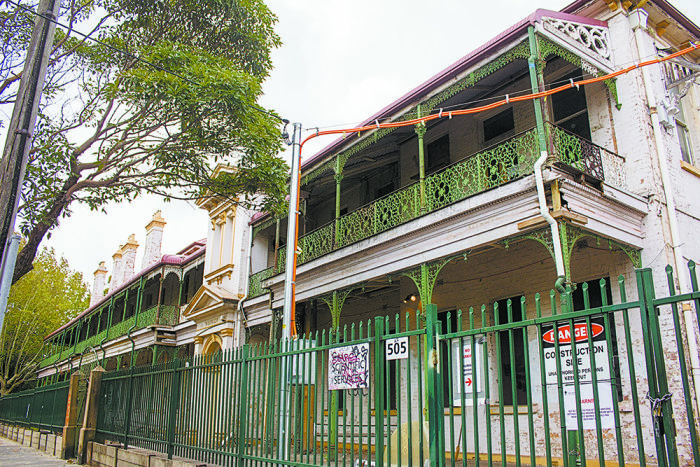
Prominently located on the ridge overlooking the workshops, its historic significance emanates from its role as an administration building that was the epicentre of technical and design expertise for all the manufacturing processes at the railway workshops, and indeed, the State’s entire railway system. It was under the supervision of the Chief Mechanical Engineer, who operated the entire workshops.
Completed in 1887, the CME accommodated the NSWGR’s (NSW Government Railways) most senior staff, whose role was to design and supervise the manufacture of railway infrastructure. This bygone era of the grandeur of steam power saw Eveleigh’s role shift from a maintenance facility towards the local manufacture of steam locomotives. The rising population of rail commuters, the need for new lines throughout the State, and the increasing dependence of commerce upon rail demanded important decisions to be made at the CME. In 1900, renovations saw the CME almost double in size to cope with these pressures.
The decision to abandon steam locomotives in 1963 meant that gradually the wheels at Eveleigh ground to a halt. Since the closure of the workshops in 1989, the building has been redundant and preserved, but not maintained.
CME has the potential to yield further substantial and cultural information in relation to the railway workshops. It is part of a group of buildings which collectively illustrates a significant establishment associated with railway history. As with other important heritage items at Eveleigh subject to adaptive reuse, the challenge is to capture and convey the site as a place of real people, relevant issues and events, not just as an assortment of redundant machines, buildings and technological processes.
At present, conservation maintenance is being carried out by UrbanGrowth NSW Development Corporation (UGDC), which took over the functions of the Sydney Metropolitan Development Authority (SMDA) at the start of 2013.
The CME is now more visible from Wilson Street, as a result of the removal of seven pollenated plane trees fronting Wilson Street. Whilst the removal of trees is not desirable in most circumstances, UGDC has advised that the retention of the trees would have caused further deterioration to the building. Additional maintenance work being undertaken includes roof repairs, stormwater drainage improvements and other essential measures to inhibit further deterioration.
A further second stage of work will involve the “specification, tendering and supervision of further essential building maintenance”, however a comprehensive plan for this important building is still undetermined.