The exhibition explores Australia’s involvement and leadership in the struggle to end apartheid in South Africa. It focuses on the background and timeline of the anti-apartheid movement and highlights the voices and memories of those involved.
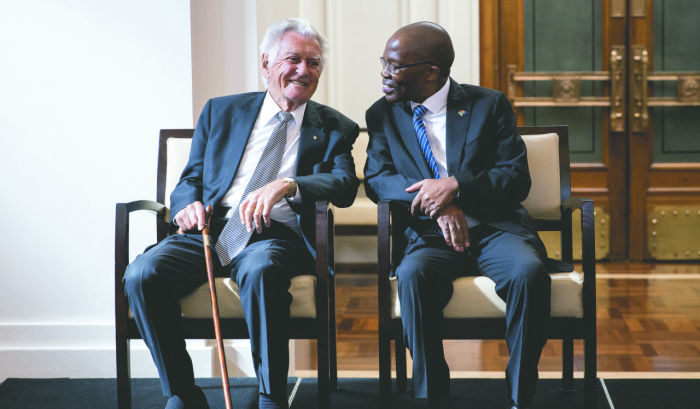
“I want all Australians to share the pride that I feel, because there is no doubt that Australia punched above its weight, and as South African Finance Minister Barend du Plessis said, “We were significant in precipitating the end of apartheid.” “There is nothing in my prime ministership of which I am more proud,” said the Hon. Robert Hawke AC, at the launch.
Old Parliament House was the venue for important discussions and decisions on Australia’s response to apartheid. Three prime ministers—Gough Whitlam, Malcolm Fraser and Bob Hawke—were active participants in making decisions that put pressure on the South African government to abolish apartheid laws.
“We are immensely grateful to all Australians for their part, aptly captured by this exhibition being launched today, and for the opportunity for current and successive generations to know where we came from and to appreciate the unbreakable bonds between our people and countries,” said His Excellency Mr Sibusiso Ndebele, South African High Commissioner, at the launch.
This exhibition explores the power of people’s voices and protest, and the lengths to which Australian activists went to support and defend this international issue. The movement in Australia was diverse and complex, and made up of many different groups and voices, including students, trade unions, churches, indigenous people, political parties and sportsmen and women, musicians, artists and cultural figures. It emphasises the extraordinary support shown by key sporting figures who personally boycotted their involvement in sporting events; actions which would later go on to affect their sporting careers.
“It’s the voices of the people that inspire what we do here; not one voice but many; not passive but active; not ignorant but informed. Memories of the Struggle is a wonderful example of this, giving voice to the many people involved and framing the past for a contemporary audience,” said Ms Daryl Karp, Director, MoAD.
On display in the exhibition is a Springbok rugby jersey worn by Gary Foley, Sir Donald Bradman’s hand written letters to Meredith Burgmann, reproductions of artwork by George Gittoes, memorabilia from Nelson Mandela’s 1990 visit to Australia, new films and interviews, and more.
April 27, 2016 also marked the 22nd anniversary of Freedom Day in South Africa, the day Nelson Mandela became the first democratically elected leader of the country in 1994.
“One of the most remarkable outcomes of this movement was the peaceful transition from a repressive government, to a democratically elected black leader, Nelson Mandela,” said Ms Karp.