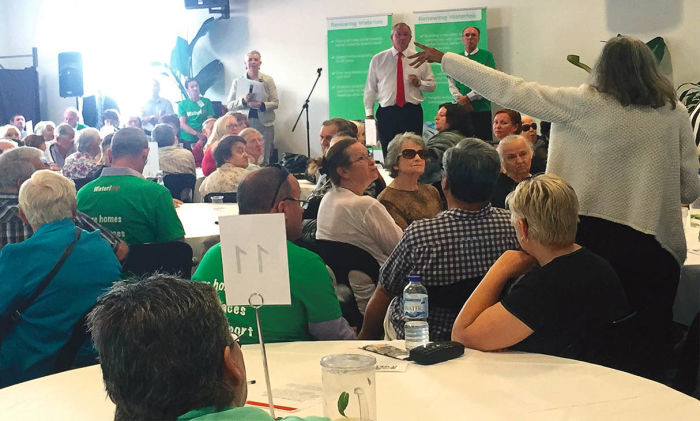
The meeting was the first of many that will focus on the proposed changes to public and social housing in Waterloo. Residents were given a chance to share their opinions directly with Brad Hazzard, Minister for Family and Community Services (FACS) and Minister for Social Housing.
The room quickly reached over-capacity, the negative atmosphere palpable as the majority had little positive regard for the minister’s justification of the redevelopment and its plans.
In fact quite quickly the meeting descended into shouting from the crowd, murmurs at each of the tables, and complaints to Mr Hazzard that the attendees were wasting their time. “This meeting has been called so the community can have their say, but not for a few people to yell over the others,” Mr Hazzard said sternly.
The information given at the event stated that Sydney Metro, FACS and UrbanGrowth NSW were working together to redevelop the area. Producing more social housing, a brand new metro station below Wellington Street, Cope Street and Raglan Street in Waterloo, and a renewed community will require tenants to relocate from their current public housing residences.
The crowd was assured that no one would be asked to move until 2017. They will be given six months notice and moved to a location of their choice. Looking to the future, after the renovations are completed in the coming 15-20 years, the residents will have the option of moving back.
One elderly woman yelled, “Excuse me, excuse me, in 20 years I’ll be dead”. The crowd roared in support, before she added: “I’ve lived here for 33 years.” It appeared to be a common theme, some having lived in Waterloo their entire lives. They want to know why they’re being moved.
Aunty Glendra of the NCIE expressed what many were thinking when she said: “People are being dispossessed and they feel powerless. People don’t want to leave.”
When it came time for Q&A, the minister had his work cut out for him.
Virginia Hickey stood and exclaimed that she’s lived at her current address in Waterloo for 25 years and in that time has come to rely on the community around her. She addressed the crowd: “It’s good to see so many people in here. I don’t care what colour you are, but we are people.” Another man shared her sentiments: “We should all clap and we should all cheer, and stick together, because this is our future.”
There were some positive and hopeful comments made.
Sean Maguire told of his hopes that local youth would be provided with apprenticeships and jobs in the renovations. He is taking a positive away from the meeting, hoping that young people will be able to “build a future”, and one day in 20 years time when the housing estate is completed, they will be able to look upon it with pride and say that they built it, and it turned their lives around.
Counterpoint Community Services EO Mike Shreenan said afterwards: “It certainly was not a great start to what will be a long process of consultation. I personally give them nine out of 10 for intention, resident turnout, venue and handouts. However, the facilitation, the answers to community questions, and rapport-building skills were abysmal. This is what happens when you allow a minister to control an event with complete disregard for the agenda and facilitator. They should have utilised the many frontline workers such as the local NGOs and government workers in the community who have a well-established relationship with tenants.
“I hope those involved in the organising will not repeat the same mistakes at future events. If they would only listen to the local community leaders, and review lessons from recent history they could avoid a lot of heartache. The event had great potential to alleviate some fears, and to create a positive dialogue but sadly it created more anxiety, more confusion and anger.”